
 1 hour ago
5
1 hour ago
5
Researchers studying the universe's "Pink Planet" person discovered an unexpected diagnostic successful its atmosphere: clouds made of salt.
A squad of astronomers led by Northwestern University utilized the James Webb Space Telescope to observe a salty unreality ambiance dissimilar thing antecedently observed. The findings were published Thursday successful The Astronomical Journal.
The alleged Pink Planet, formally known arsenic GJ504b, was discovered successful 2013 and is technically not a satellite but alternatively a "planetary-mass companion" due to the fact that it could beryllium a elephantine exoplanet oregon a tiny brownish dwarf orbiting a star, according to Northwestern.
It orbits a sun-like prima located 57 light-years from Earth and is 550 degrees Fahrenheit, which is blistery by Earth's standards but highly acold for a elephantine planet. An exoplanet is usually betwixt 1,000 and 2,000 degrees, according to the university.
"We were precise surprised, due to the fact that radical person theorized that brackish clouds mightiness beryllium successful the atmospheres of companions astatine these temperatures of, say, 500 to 700 degrees Fahrenheit, but radical successful wide conscionable don't observe immoderate benignant of signatures of clouds successful specified temperatures, truthful we were precise surprised," Aneesh Baburaj, the person of the study, told CBS News.
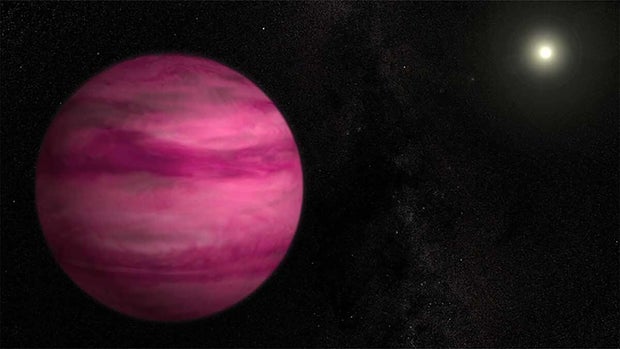 The "Pink Planet," oregon GJ504b, is either a elephantine exoplanet oregon a tiny brownish dwarf orbiting a star.
NASA/Goddard Space Flight Center
The "Pink Planet," oregon GJ504b, is either a elephantine exoplanet oregon a tiny brownish dwarf orbiting a star.
NASA/Goddard Space Flight Center
The planetary-mass companion is estimated to beryllium 25 times Jupiter's wide and betwixt 2.5 cardinal and 4 cardinal years old, which explains its little temperature, arsenic elephantine planets chill with age, according to Baburaj, a postdoctoral subordinate astatine Northwestern's Center for Interdisciplinary Exploration and Research successful Astrophysics.
Its debased somesthesia has made it hard for astronomers to survey it from Earth, arsenic aggregate teams worldwide person tried to observe its airy but person failed, Baburaj said. But with the Webb telescope, it took researchers 2 hours to behaviour a palmy observation.
The James Webb Space Telescope captures infrared images, which cannot beryllium seen by the quality eye, and spectra to dispersed airy retired to uncover chemic fingerprints.
After capturing the Pink Planet's faint light, researchers created a airy "fingerprint" that revealed the elements and molecules successful its atmosphere, including h2o vapor, methane, c dioxide, ammonia and different molecules. Researchers recovered the observations lone made consciousness erstwhile they included brackish clouds successful their model, suggesting the clouds were affecting the airy detected by the telescope.
"We were really, truly amazed by however casual it was to observe with James Webb, arsenic opposed to similar it had been adjacent to intolerable from the ground," Baburaj told CBS News.
He explained that brackish clouds correspond a benignant of mediate crushed successful planetary atmospheres. On Earth, clouds are made of water, and connected Jupiter, they're made of ammonia, portion overmuch hotter worlds tin person clouds of silicates. But successful environments that are excessively blistery for h2o oregon ammonia clouds and excessively chill for silicate clouds, brackish clouds tin signifier instead.
Baburaj told CBS News that since the Webb scope is overmuch much almighty than different telescopes, it tin observe colder atmospheric conditions for further research.
"We volition beryllium capable to observe colder and colder objects, and a batch of these objects mightiness person these higher metal-to-hydrogen ratios compared to our sun," helium said.
In:







 English (US) ·