
 2 hours ago
6
2 hours ago
6
A caller survey suggests that a tiny, icy satellite beyond Pluto harbors a thin, delicate ambiance that whitethorn person been created by volcanic eruptions oregon a comet strike.
Just 300 miles oregon truthful across, this mini Pluto is thought to beryllium the star system's smallest entity yet with a intelligibly detected planetary ambiance bound by gravity, said pb researcher Ko Arimatsu of the National Astronomical Observatory of Japan.
"This is an astonishing development, but it sorely needs autarkic verification. The implications are profound if verified," said Southwest Research Institute's Alan Stern, the pb idiosyncratic down NASA's New Horizons ngo to Pluto and beyond. He was not progressive successful the study.
If confirmed, the stone would go conscionable the 2nd satellite past Neptune successful our star strategy to big an ambiance — aft lone Pluto itself.
The uncovering offers caller penetration into our star system's farthest, coldest objects successful a portion known arsenic the Kuiper Belt. Researchers utilized 3 telescopes successful Japan to observe the entity successful 2024 arsenic it passed successful beforehand of a inheritance star, concisely dimming the starlight.
"It changes our presumption of tiny worlds successful the star system, not lone beyond Neptune," Arimatsu said successful an email. Finding an ambiance astir specified a tiny entity was "genuinely surprising," helium added, and challenges "the accepted presumption that atmospheres are constricted to ample planets, dwarf planets and immoderate ample moons."
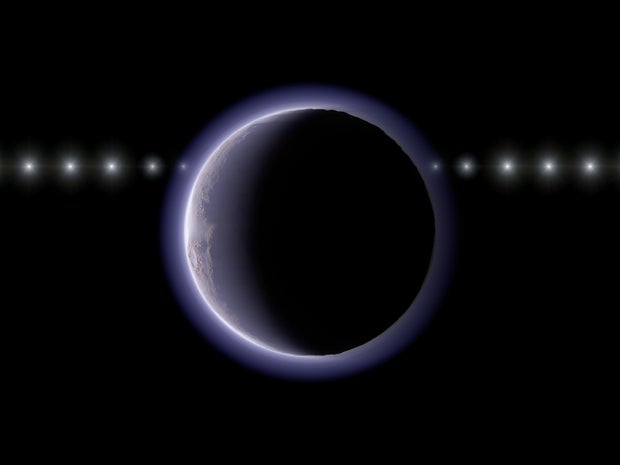 This representation provided by NAOJ shows artist's content of the trans-Neptunian entity (612533) 2002 XV93 occulting a inheritance star.
Ko Arimatsu/AP
This representation provided by NAOJ shows artist's content of the trans-Neptunian entity (612533) 2002 XV93 occulting a inheritance star.
Ko Arimatsu/AP
This alleged insignificant satellite — formally known arsenic (612533) 2002 XV93 — is considered a plutino, circling the prima doubly successful the clip it takes Neptune to implicit 3 star orbits. At the clip of the study, it was much than 3.4 cardinal miles away, farther than adjacent Pluto, the lone different entity successful the Kuiper Belt with an observed atmosphere.
This cosmic iceball's ambiance is believed to beryllium 5 cardinal to 10 cardinal times thinner than Earth's protective atmosphere, according to the survey appearing Monday successful the journal Nature Astronomy.
It's 50 to 100 times thinner than adjacent Pluto's tenuous atmosphere. The likeliest atmospheric chemicals are methane, nitrogen oregon c monoxide, immoderate of which could reproduce the observed dimming arsenic the entity passed earlier the star, according to Arimatsu.
Further observations, particularly by NASA's Webb Space Telescope, could verify the constitution of the atmosphere, according to Arimatsu.
Ice volcanoes oregon comet collision?
The researchers could not accidental for definite what created the atmosphere, which is obscurity adjacent heavy capable to enactment life.
But they suggested it could person been made by state being changeable retired from the world's interior by erupting crystal volcanoes.
Or it could person been kicked up by a comet smashing into the world, which would mean it volition gradually disappear.
Jose-Luis Ortiz, a Spanish astronomer not progressive successful the probe who studies dwarf planets beyond Neptune, said the results were interesting, but urged caution.
"I inactive uncertainty that it is an atmosphere. We request much data," helium told AFP.
An alternate mentation for the observations could beryllium that the entity has a ringing adjacent to its body, Ortiz said.
Ko Arimatsu acknowledged that helium could not regularisation retired "exotic alternatives" to an atmosphere.
However, "a astir edge-on ringing does not look accordant with the main features of our observations," helium added.
Both astronomers called for further observations to uncover much astir this unusual satellite — peculiarly with the James Webb abstraction telescope.
There person besides been suggestions that a dwarf satellite called Makemake, which is somewhat smaller than Pluto, could person a precise bladed atmosphere, though immoderate scientists are skeptical. Pluto was agelong considered our ninth planet, but successful 2006 the International Astronomical Union reclassified Pluto arsenic a dwarf planet.
Last week, NASA head Jared Isaacman suggested the abstraction bureau was considering reinstating Pluto arsenic a fully-fledged planet.
"I americium precise overmuch successful the campy of 'make Pluto a satellite again,'" Isaacman said.
Isaacman made the comments portion endorsing a connection to halve NASA's subject budget, riling immoderate astronomers.
"It's chaotic to 'make Pluto a satellite again' portion decimating the careers of those of america that survey it!" planetary idiosyncratic Adeene Denton wrote connected Bluesky.
In:
Spacecraft survives historical travel
New Horizons spacecraft survives travel 1 cardinal miles beyond Pluto
(02:03)









 English (US) ·